
China should just ban these “cars.”
They are a threat to public safety.
AP:
Zhang Yazhou was sitting in the passenger seat of her Tesla Model 3 when she said she heard her father’s panicked voice: The brakes don’t work! Approaching a red light, her father swerved around two cars before plowing into an SUV and a sedan and crashing into a large concrete barrier.
Stunned, Zhang gazed at the deflating airbag in front of her. She could never have imagined what was to come: Tesla sued her for defamation for complaining publicly about the car’s brakes — and won. A Chinese court ordered Zhang to pay more than $23,000 in damages and publicly apologize to the $1.1 trillion company.
Zhang is not the only one to find herself in the crosshairs of Tesla, which is led by Elon Musk, among the richest men in the world and a self-described “ free speech absolutist.” Over the last four years, Tesla has sued at least six car owners in China who had sudden vehicle malfunctions, quality complaints or accidents they claimed were caused by mechanical failures.
The company has also sued at least six bloggers and two Chinese media outlets that wrote critically about the company, according to a review of public court documents and Chinese media reports by The Associated Press. Tesla won all eleven cases for which AP could determine the verdicts. Two judgments, including Zhang’s, are on appeal. One case was settled out of court.

The February 2021 crash in central China’s Henan province sent Zhang’s mother and father, who had a concussion, to the hospital for four days, medical records show. Zhang — who was unharmed in the accident, as was her baby niece — wanted to understand what had happened: How could her dream car have turned into such a nightmare?
Traffic police determined that the crash was her dad’s fault because he hadn’t maintained a safe following distance. Zhang, however, insisted that the brakes had malfunctioned, sending the car out of control. She filed a complaint with a local market regulator, requesting a refund and compensation. Teslas are among the most computerized cars on the market, so Zhang asked the automaker to turn over the full pre-crash data from her car, hoping it might help explain what went wrong. Tesla refused.
“Tesla’s employees were very arrogant and tough in dealing with my complaints,” Zhang said in an interview. “I was burning with anger.”
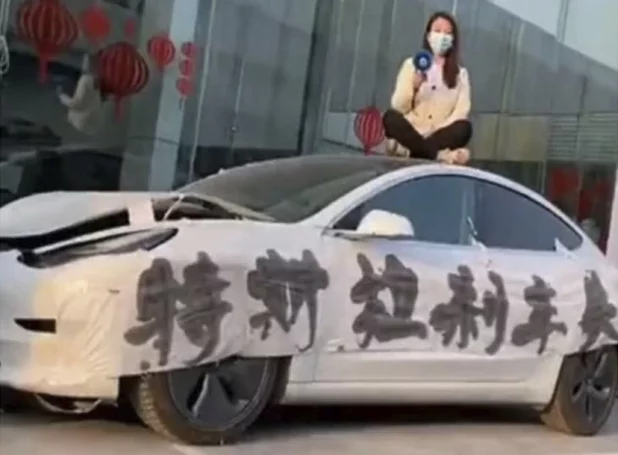
After weeks of stewing, she draped her damaged car with a banner proclaiming “Tesla brake failure” in front of the Tesla dealership in Zhengzhou, the capital of Henan province, some 200 km (124 miles) from her home. She sat on the Tesla’s roof and blared her protest through a bullhorn: “Tesla Model 3 brakes failed,” she said. “A family of four almost died.” The next month, she parked her damaged car outside an auto show in Zhengzhou. It was all to no avail — Tesla refused to turn over the full data and mediation went nowhere.

Tesla said Zhang had deliberately spread false information that damaged the brand and asked for 5 million yuan ($684,000) in damages.
The case, which a court took up in October 2021, came as Tesla faced a barrage of criticism in China.
Dozens of Tesla owners had been publicly complaining about alleged brake failures, battery fires, unintended acceleration and other defects, as well as what they claimed were misleading sales practices. The same month as Zhang’s crash, Chinese regulators summoned Tesla to respond to quality concerns raised by such reports.
Zhang’s emotional protest sparked a rare burst of criticism of Tesla in Chinese media. Under pressure from regulators, Tesla finally released the data from her car, which the company said showed her father had been driving nearly 120 km per hour (75 mph) and that the brakes had functioned to reduce the magnitude of the collision.
Tesla had finally given Zhang what she’d been asking for, but they’d published the data publicly and included her vehicle identification number. She said she and her family started getting threatened and doxed online. Besides, she wondered, how could she be sure Tesla hadn’t modified or redacted the data from her car? It was less than the victory she’d hoped for. Feeling besieged, she sued Tesla a second time, in March 2022, for invading her privacy.
Zhang lost both cases she brought against Tesla.
Meanwhile, the defamation case against her was grinding along. Back in court as a defendant, Zhang was unable to prove that the brakes on her Tesla had indeed failed. In a closed trial, a Shanghai court ruled in May 2024 that Zhang’s public complaints went beyond what magistrates considered reasonable, factual criticism and ordered her to publicly apologize and pay 170,000 RMB ($23,000) to cover damages and the legal costs of the world’s most valuable car company.
Zhang appealed the ruling. She maintains that her lawsuit is a cry for transparency and accountability and that a company as rich and powerful as Tesla should be able to tolerate legitimate criticism from its customers.
“I refuse to accept it,” Zhang told the Associated Press, “As a consumer, even if I said something wrong, I have the right to comment and criticize. I spoke about my feelings as a user of the car. It has nothing to do with damaging their reputation.”
Her odds of winning the appeal against Tesla do not look good. Tesla has not only won the defamation cases it brought against unhappy car owners and critical journalists, it’s also prevailed in lawsuits customers have filed against it.

Zhang posted videos about it on her Weibo account.
Safety advocates worry about the implications of Musk’s proximity to power in the United States. Federal investigations and safety initiatives Musk has long railed against could be easily snuffed out by the new administration.
In the U.S., Tesla also has been subject to a raft of customer safety complaints and lawsuits over autopilot function, battery charging, alleged suspension defects, sudden braking or acceleration, faulty airbags and allegedly monopolistic practices on repairs and parts. Judges have dismissed some cases. In others, Tesla settled out of court or paid hefty settlements.
Tesla has not publicly sued any of its U.S. customers for speaking out, though in January, Musk said on X that “maybe it is time” to sue media outlets for coverage that could stain Tesla’s brand. His post has been viewed more than 22 million times.
Tesla has already successfully done that in China.
It’s sort of ironic about the “free speech” thing, no?